Connections
A connection stores access to a remote Jira Cloud site. Only Jira administrators can create or edit a connection, rotate its token, or deactivate it. The list shows its status and the token expiry date, if configured.
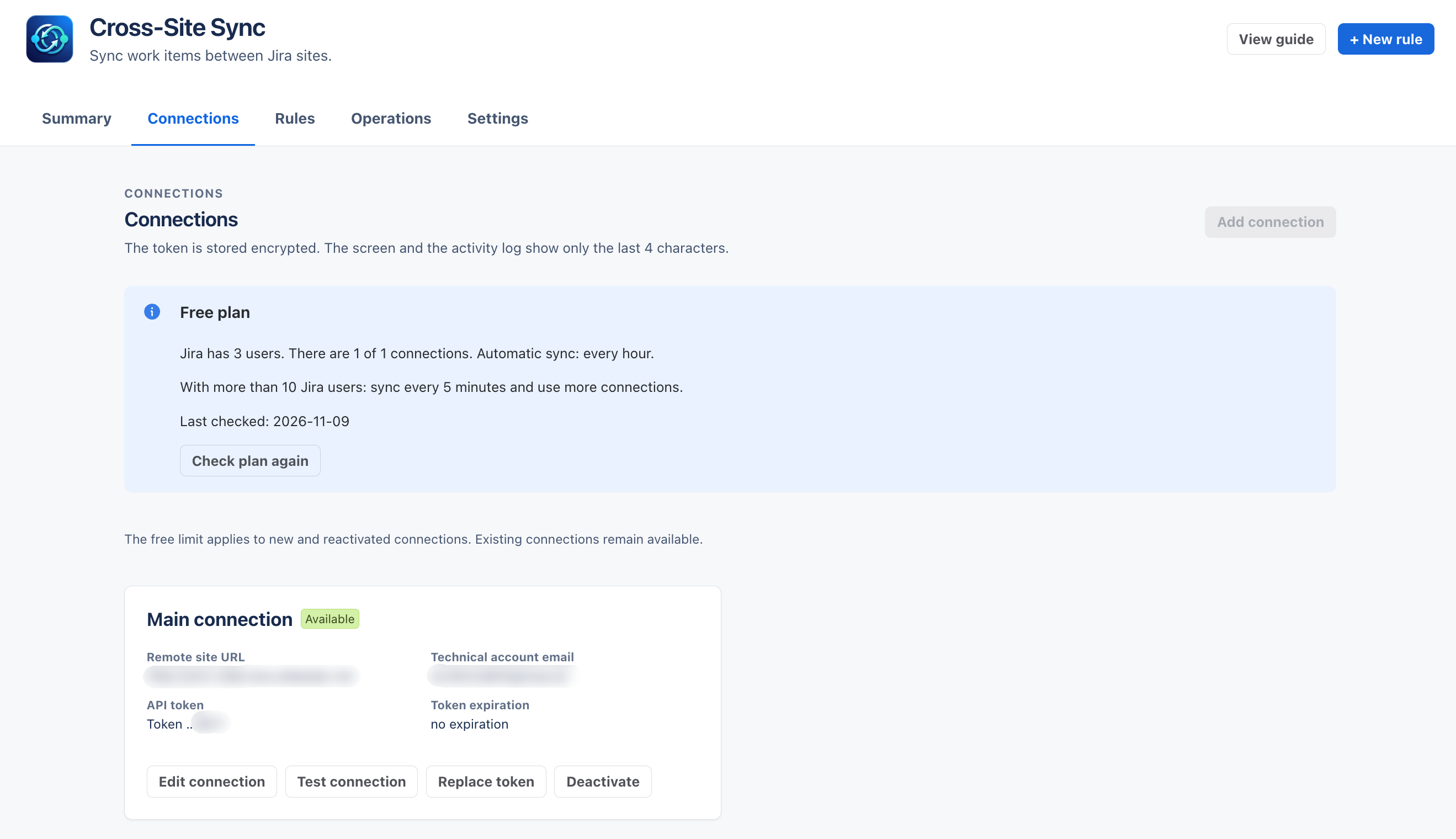
Check the plan and connection limit
Administration shows the site's plan, connection usage, and automatic sync frequency. The indicator uses the format Jira has {users} users. There are {connections} of {limit} connections. Automatic sync: {frequency}. On the free plan, the limit is one connection and sync runs every hour; on the paid plan there is no artificial limit and sync runs every five minutes. The free-plan card also says: With more than 10 Jira users: sync every 5 minutes and use more connections.
The button disabled at the limit is Add connection; New connection is the form title. The free limit applies to new connections and reactivations; existing connections remain available. Select Check plan again to refresh the plan; the card also displays Last checked: {date}. If the site exceeds 10 users, the paid-plan terms apply; if it drops to 10 or fewer, existing connections are kept, new connections and reactivations are blocked, and automatic sync becomes hourly.
If the plan cannot be checked, the interface displays: The plan could not be checked. Paid capabilities remain enabled; check again or retry later.
Add and test a connection
- Open Cross-Site Sync for Jira administration and select Connections.
- Choose the option to add a connection.
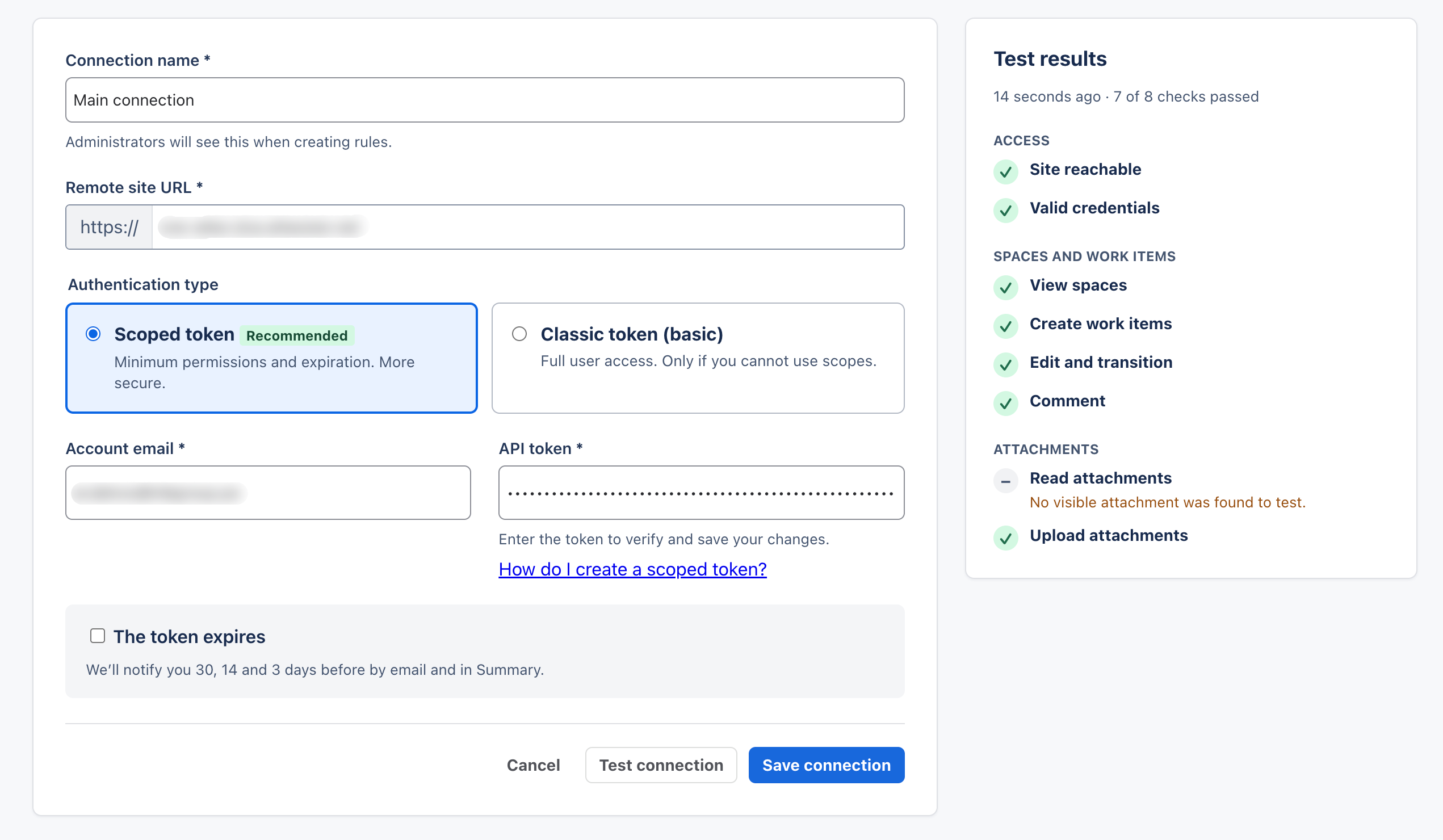
- Enter a name and the remote site URL. Under Account email, enter the email for the account used by the connection and its API token. The form recommends using a service account.
- Select Scoped token (recommended) or Classic token (basic) and, if applicable, enter its expiry date.
- Select Test connection before saving. The results group checks for access, spaces and work types, and attachment permissions. Each problem includes guidance on how to fix it. After the checks finish, select Save connection.
The account used by this connection must be able to create work items in the remote destination space. Permissions for comments and attachments depend on the features enabled in each rule. If the test fails, check the URL, token, and account permissions before trying again.
Protect and rotate the token
- The token is stored encrypted. The interface only shows part of it; you cannot retrieve the full token from the screen.
- To replace the token, select Replace token, enter the new value, and run the test. The app checks the credential before replacing the old one.
- If the token expires, set its expiry date. You can change the notice thresholds in settings; notices are sent by email and appear in Summary.
- If the token expires or the remote site rejects it, the connection needs attention. Pending jobs are paused and kept; fix the connection and resume it to continue.
Connection states
| State | Meaning | What to do |
|---|---|---|
| Available | The connection was validated. | You can use it in a rule. |
| Credential rejected | The remote site did not accept the token. | Check or rotate the token, then test again. |
| No permission | The technical account does not have enough access. | Ask the remote site's administrator to review the account permissions. |
| Site unreachable | The app could not reach the remote site. | Check the URL and site availability, then test again. |
| Deactivated | An administrator deactivated the connection. | Reactivate it or create another connection, if needed. |
The app checks connection health daily. Deactivating a connection requires confirmation and pauses its rules and pending jobs; it does not remove existing links.