Sync rules
A rule defines which work item to create on the remote site, when to create it, and what content to transfer. Before creating a rule, set up an available connection and make sure the technical account can create work items in the destination.
Configure a rule
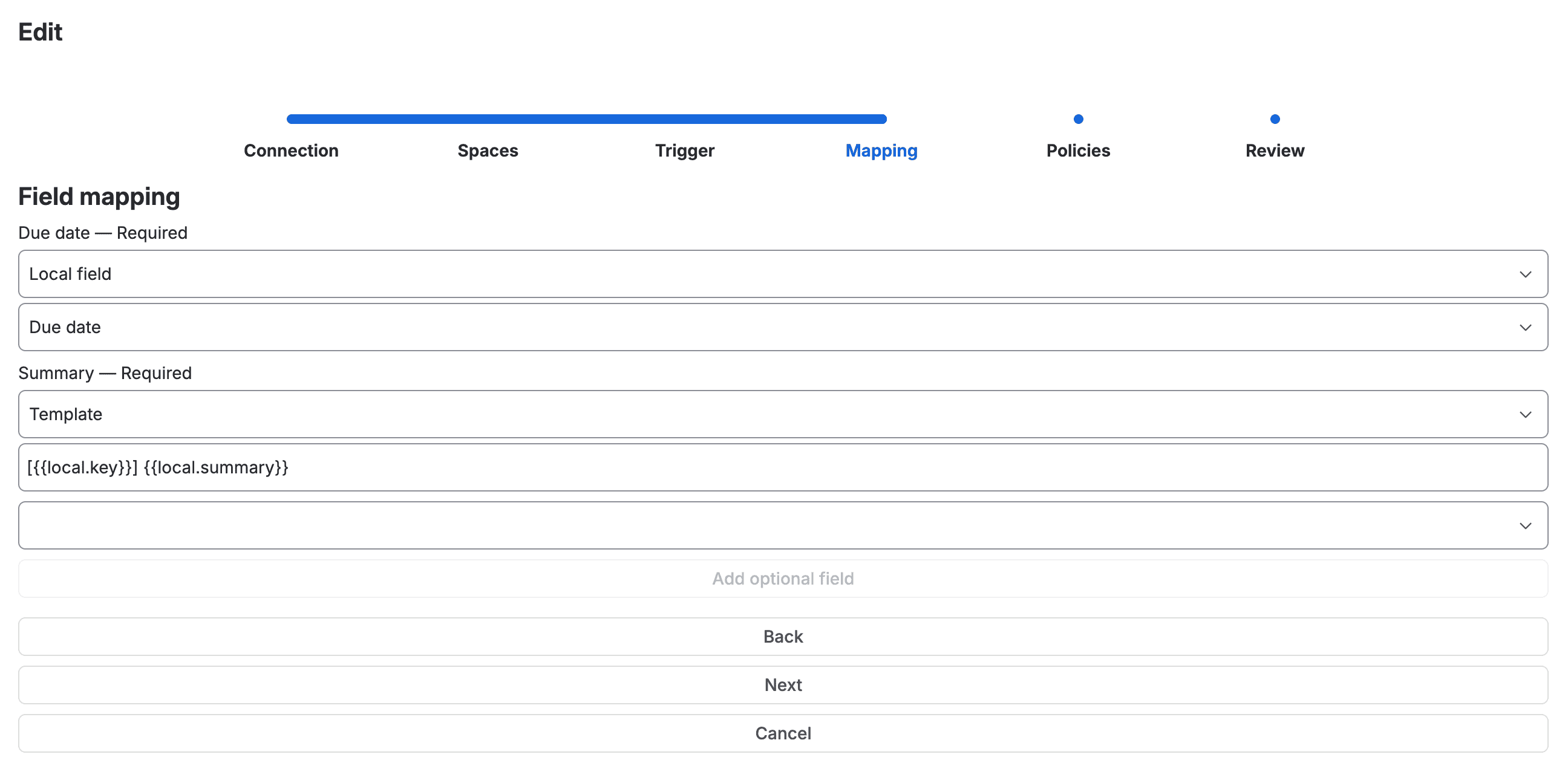
The wizard has six steps:
- Connection: choose the remote site and give the rule a clear name.
- Spaces: select the local space and work item type, and the remote space and type.
- Trigger: choose a workflow transition, a field value, or manual escalation from the panel.
- Mapping: map local fields to fields on the remote work item.
- Policies: choose which comments and files to transfer and the language for app notices.
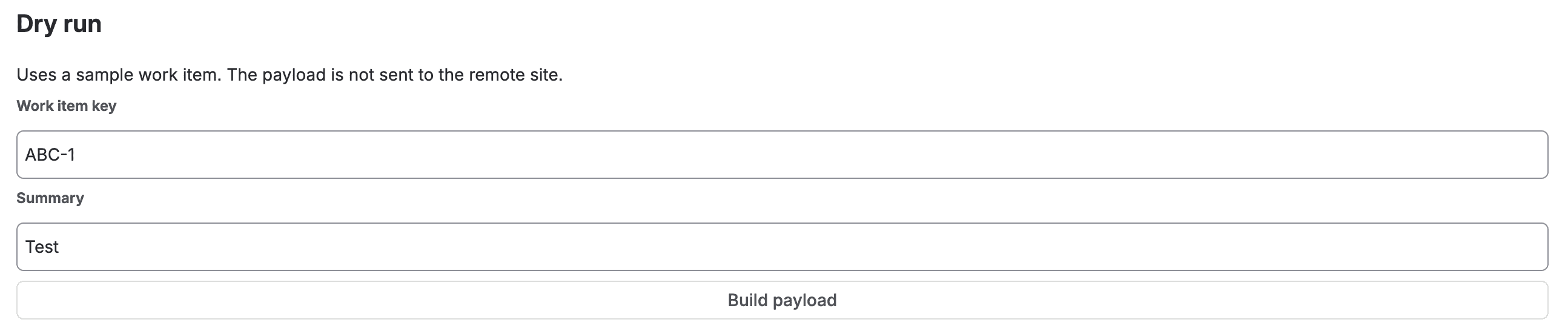
- Review: check the configuration and select Build payload to generate a dry-run preview. Then choose Save as inactive or Save and activate.
A rule cannot be saved if its connection is unavailable, the account lacks create permission, a required remote field is unmapped, the work item types are incompatible, or an active condition is duplicated. The message explains what to fix.
Map fields
For each remote field, choose one of these sources:
- Local field: copy the value from the local work item.
- Fixed value: use the same value for every remote work item created by the rule.
- Template: combine text with values such as
{{local.key}}and{{local.summary}}. - Option translation: convert local values to remote values and set a default.
Remote user fields only support a fixed value. The app does not look up or automatically convert a local user into an account on the remote site. To set the destination user, enter the fixed account id of a valid account on the remote site as a fixed value.
Keep the local key in the summary
The remote work item's summary must include {{local.key}}, the local work item key. Without a custom mapping, the default is:
[{{local.key}}] {{local.summary}}
The key identifies the source and helps prevent duplicates if an operation is retried. The rule cannot be saved if its summary template omits the key.
Choose when to create the remote work item
- Transition: create the remote work item when the selected workflow transition runs. You can add a workflow validator to check required fields first.
- Field value: create it when the field has one of the selected values. If a required remote field is missing, the transition is not blocked; the local work item receives an error notice.
- Manual only: an authorized user selects Escalate in the panel.
The same rule and local work item create at most one remote work item. A double-click, retry, or delayed response does not create another one.
Configure comments
For comments sent from the local site, choose:
- All: send new comments.
- With a prefix: send only comments that start with the selected prefix; you can remove the prefix when sending.
- Panel only: send only comments written from the panel action.
Jira Service Management internal notes are not sent unless the rule explicitly allows them. On the way back, new comments from the remote site arrive on the local work item with an authorship header. In Jira Service Management, choose whether they should be internal or public. Comments written by the technical account are not imported again.
The app prevents loops and duplicate comments. If a comment exceeds 32,000 characters, it is truncated with a note that the original text continues on the source work item.
Configure attachments
Choose a policy for each direction:
- None: do not transfer attachments.
- Referenced in comments: transfer files mentioned in comments that are synced.
- All new: try to transfer new attachments covered by the rule.
The default maximum size is 10 MB per file. Some extensions are blocked. If a file is skipped because of its size, extension, or permissions, the app explains why in a destination comment and the activity log. A file that was already copied is not uploaded again, and files uploaded by the app are not sent back to the other site.
Version 1.0.0 limitation: the All new policy does not copy attachments added after the initial escalation. To transfer them, cite the attachment in a synced comment.
Rich text is adapted for the other site: mentions become @Name and do not notify remote users; inline images become [Attachment: file] and are transferred as attachments. Unsupported content is replaced with [Unsupported content omitted].
Language and dry run
Under Template language, choose Spanish or English for notices the app writes to work items. English is the default. This is independent of the interface language, which is available in Spanish, English, and Brazilian Portuguese.
Before activating a rule, select Build payload on the Review step with a sample work item. The dry-run preview shows the fields that would be sent and does not create or change anything on the remote site. If you change the rule or sample, select Build payload again to review the updated result.